remove the fixed tick
The risk of transmission of Borrelia increases with the duration of attachment.


05Vector risks
A fixed tick should be removed as soon as possible, without crushing or applying any product before removal. The useful line combines mechanical extraction, disinfection, date identification and surveillance of skin and general condition.

AnswerThe essential first
In practice
Remove the tick as soon as possible with a tick removal tool or, if unavailable, fine-tipped tweezers. Grasp it as close to the skin as possible without squeezing its body and follow the tool’s instructions. After removal, disinfect the area, wash your hands, record the date and monitor your skin and general health for four weeks. Seek medical advice if a red patch expands or unusual symptoms occur.
The risk of transmission of Borrelia increases with the duration of attachment.
Photograph a redness to compare its evolution and see if it extends.
Ether, oil, alcohol or other substances are not recommended on a tick that is still attached.
01Understanding the situation
A small immediate redness at the point of withdrawal may be a local reaction. A plaque that gradually spreads or general signs require medical advice.
Remove it promptly with a suitable tool. Do not crush the tick or apply any product to it.
Don't insist on aggressive gestures. Ask a pharmacist or doctor for advice.
Clean up, date and watch. Limited irritation just after withdrawal is not a migrant erythema alone.
Take a photo with a size marker and see: erythema migrant requires a medical assessment.
Consult with the date, probable location and circumstances of the injection.
02Step by step
Prepare a size-suited tick, an antiseptic, and a date note. In a child or in a difficult area, ask for help.
Lighten the skin and spread clothes or hair without handling the tick with the fingers.
Place the hook as close as possible to the skin, under the tick, without compressing the abdomen.
Follow the leaflet of the tick, usually with gentle and continuous traction-rotation.
Observe the area; if a part seems to remain, do not hurt the skin while trying to extract it.
Apply a suitable antiseptic after removal, then clean your hands.
Keep the date and likely location of the exposure and monitor the area for four weeks.
03Decision points
The context determines the right measure. Use these markers to choose the next action and when to ask for help.
A rounded redness that grows within days or weeks of the injection should be evaluated.
Fever, malaise, unexplained pain, weakness or neurological disorder warrant consultation.
Pregnancy, young child, immunosuppression, very sippy tick or withdrawal impossible: ask for advice quickly.
In practiceObserve and understand
Species, location and circumstances help document exposure, but a photograph cannot tell whether a tick carries a pathogen. Species differ by region; the American photograph below is not an atlas of European ticks.
| Information | What it helps establish | What it does not prove |
|---|---|---|
| Date and place | The timing and area of exposure. | The presence of a pathogen in the tick. |
| Removal | When the tick was removed. | Certainty that no transmission occurred. |
| Developments | Signs appearing in the following days or weeks. | A single cause without medical assessment. |
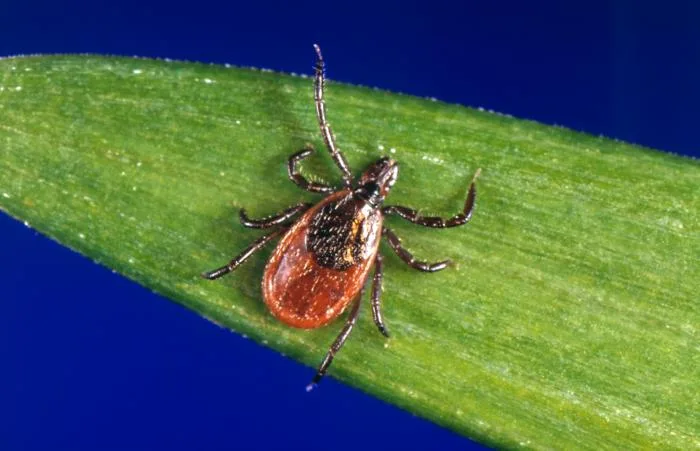
Remove an attached tick promptly as explained in the guide. Seek medical advice for fever or a rash in the following days or weeks and mention the date, location and bite. Do not wait for any tick-test result before consulting.
04Not to be done
No. Health authorities advise against applying substances to an attached tick. Use a tick removal tool or fine-tipped tweezers to remove it mechanically without squeezing it.
No. Minor irritation may appear at the removal site. However, a round red patch that gradually expands over the following days or weeks requires medical advice.
Serology is not indicated for routine screening after injection without clinical manifestation. A doctor decides on examinations according to the signs and context.
Public Health France recommends monitoring the area for four weeks and consulting in case of migrating d-erythema or general signs.
These points serve as a reminder to prepare the action. The boxes are not registered.
Organize the chronology and documents to bring, without delaying a quick notice when it is necessary. Fill in the aide-memoire for a medical exchange →
These institutional references provide a means of checking the guide and accessing the full recommendations.
PratiqueCheck before deciding
Use alongside the guide’s steps, limitations and sources.