General information, not a diagnosis Method and limitations

Fact sheetVirus

Norovirus

Norovirus causes highly contagious gastroenteritis. The main immediate risk is dehydration.

Documentary Enrichment: · General information

Essentials

Frequent cause of acute, highly contagious gastroenteritis in communities and feco-oral transmission.

Agent
Norovirus
Transmission or exposure
Water and food · Close contact

Situation and vulnerability

Young children, the elderly and immunocompromised persons may have more difficulty in compensating for water losses.

Signs and limits of their interpretation

Vomiting, diarrhoea, nausea and abdominal pain often appear abruptly. Decreased urine, dizziness or unusual sleepiness may indicate dehydration.

Diagnosis and monitoring

The examination especially appreciates hydration and severity. Research into stools can be used, in particular, in a collective episode; it is not necessary for each patient.

Check these markers in the CDC reference →

Prevention and care

Wash hands with soap and water. According to the CDC, wait at least 48 hours after symptoms end before preparing food for others.

Practical issues

Does hydroalcoholic gel replace soap for norovirus?

No. The CDC points out that the gel alone works badly against the norovirus; it does not replace soap washing.

Preparing for an exchange with a professional

  • Start and frequency of vomiting and diarrhoea
  • Capacity to drink and quantity of urine
  • Common meals and other sick persons

Bring the full minutes and dates. This information facilitates evaluation; its collection must not delay an urgent appeal.

Individual decisionThe choice of a test, treatment or prevention depends on the local situation and recommendations. In case of distress, call 911.
Plan de travail propre avec des légumes et des ustensiles séparés. AI-generated illustration.
Preparing food - Clean work plan with separate vegetables and utensils.
Image generated by artificial intelligence. Illustration IA; it does not prove the absence of contamination.

Organize my dates, documents and questions →

Related fact sheets

These sheets share ways or contexts of exhibition in our catalogue. This reconciliation does not establish a differential diagnosis.

Compare Norovirus with associated plugs →

Return to directory file →
In practiceObserve and understand

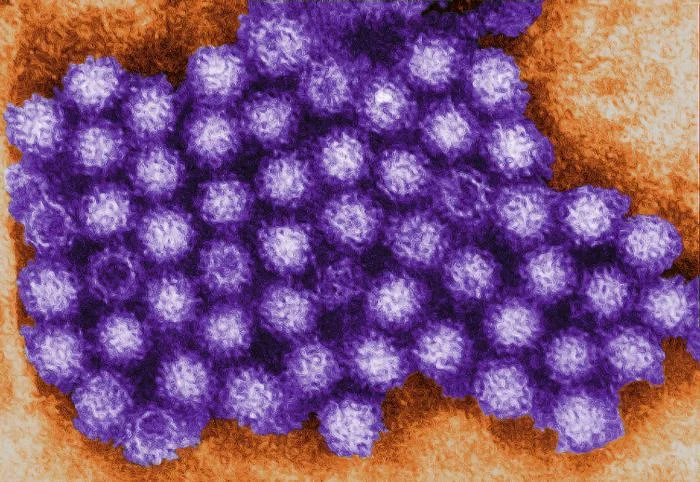
What a micrograph reveals, and what it cannot tell you

A laboratory image records an observation at a scale invisible to the naked eye. It does not show whether food, surfaces or people around you are contaminated.

What a micrograph reveals, and what it cannot tell you — explanations and limits
BackgroundPrevention referenceLimit
HandsSoap and water are essential against norovirus.Hand sanitiser alone works less well against this pathogen.
Meal preparationCDC recommends not preparing food while ill and for at least 48 hours after symptoms stop.Workplace or local guidance may be more specific.
Soiled surfaceFollow norovirus-specific guidance and the product instructions.A visibly clean surface does not prove viruses are absent.
Digitally colourised transmission electron micrograph of a group of norovirus particles
Real electron microscope observation with digital colour added. CDC / Charles D. Humphrey. Public domain. Free source: CDC PHIL, image 10708. Added colours aid interpretation; this image is not a contamination test.
Keep in mind

The photograph is a real observation with digital colour added. Its colours are not those of the virus seen with the naked eye and do not indicate its danger.

References for these explanations

Sources consulted on . Examples and diagrams are educational; the original guidance defines its scope.

Further reading

These publications help you verify the concepts discussed. Disease records and directory entries each identify their sources.

The content modification date does not mean that every source has undergone a new medical review. Verification method and scope.